One-Pan Chickpea Rice With Pantry Staples
- The short answer
- What you need
- How do you measure canned chickpeas consistently?
- How should you read the sodium label?
- Build the flavour base first
- Cover and cook without losing the steam
- What if the rice is still firm?
- Which substitutions preserve the absorption plan?
- How should leftovers be cooled and reheated?
- Final pantry checklist
- Sources
The short answer
One-pan chickpea rice needs a fixed rice ratio and well-drained chickpeas. Measure 1 1/2 cups of drained chickpeas rather than relying on can size, soften the vegetables first, then add one cup of extra-long-grain white rice and two cups of broth. Bring the whole pan back to a simmer, cover and cook on low for 20 minutes. Rest for five minutes before adding lemon and herbs.
This makes a pantry dinner for four without turning the rice wet or leaving a hard layer at the centre.
What you need
Use a 12-inch skillet or wide 4-quart pot with a lid that closes fully.
For four portions:
- 1 1/2 level cups drained canned chickpeas
- 1 tablespoon olive oil
- 1 small yellow onion, about 5 ounces (142 g), cut into 1/4-inch dice
- 1 medium carrot, about 4 ounces (113 g), cut into 1/4-inch dice
- 2 garlic cloves, finely chopped
- 1 teaspoon ground cumin
- 1 teaspoon sweet paprika
- 1/2 teaspoon ground coriander
- 1/4 teaspoon black pepper
- 1 cup (about 185 g) dry Mahatma extra-long-grain white rice, not instant or parboiled
- 2 cups (473 ml) low-sodium vegetable broth or water
- 1 tablespoon lemon juice
- 2 tablespoons chopped parsley, optional
- fine salt, only after tasting
The serving arithmetic is direct: one cup dry rice divided among four portions is 1/4 cup dry rice per person, while 1 1/2 cups chickpeas divided by four is 3/8 cup per person.
Mahatma's current product directions use two cups of liquid for one cup of this rice and specify a covered 20-minute stovetop simmer. This recipe preserves that ratio and time. The maker also permits broth in place of water.
How do you measure canned chickpeas consistently?
Check the can before opening. FoodSafety.gov says not to buy or use cans that are damaged, swollen, rusted or dented.
Can sizes, packing liquid and drained yield vary. Open the can, tip the chickpeas into a sieve and rinse them under cool running water. Let them drain for two minutes, shaking the sieve twice. Then measure 1 1/2 level cups. Use that measured amount in the skillet; refrigerate any excess promptly in a covered container.
Do not include the can liquid in the two-cup cooking-liquid measure. It would change both the water balance and the seasoning. The two cups must be broth, water or a measured combination of the two.
Home-cooked chickpeas can replace canned only when they are already fully cooked, drained and measured to the same 1 1/2 cups. Firm, partly cooked dried chickpeas will not become reliably tender on the rice schedule.
How should you read the sodium label?
Sodium depends on the exact chickpea and broth products. Read the amount per stated serving and the number of servings in each container. “No salt added” and “low sodium” are label claims for particular products; do not transfer them to another can or to the completed recipe.
Rinsing changes what goes into the skillet, but this recipe does not assign an invented percentage reduction.
Using low-sodium broth gives you more control at the end. Still, compare its label with the chickpea label before deciding whether to add salt. Taste only after the rice is cooked, then season in small pinches.
Build the flavour base first
Heat the skillet over medium heat for two minutes. Add the olive oil, onion and carrot. Cook for six minutes, stirring each minute, until the onion is translucent and the carrot has started to soften. Keep the heat moderate; browned edges are useful, while black spice or garlic will make the broth bitter.
Add the garlic, cumin, paprika, coriander and black pepper. Stir for 30 seconds. Add the dry rice and stir for one minute, coating the grains in the seasoned oil.
Pour in exactly two cups of broth or water. Scrape the base of the pan with the wooden spoon so no rice remains stuck in a dry patch. Stir in the measured chickpeas and spread everything into an even layer.
Bring the liquid to a steady simmer across the pan. This return to simmer matters, especially if the chickpeas were refrigerated. Putting the lid on while the mixture is merely warm makes the 20-minute clock start too early.
Cover and cook without losing the steam
Once the full pan simmers, cover it and reduce the burner to low. Cook for 20 minutes. Do not lift the lid during the first 18 minutes.
At 20 minutes, turn off the burner and lift the lid away from your face. Check rice from the centre and near the edge. The grains should be tender without a hard core, and there should be no pool of loose liquid. Taste a chickpea as well; it should be hot throughout and retain its shape when handled gently.
If both checks pass, replace the lid and move the pan off the heat for five minutes. The rest distributes moisture through the rice. Fluff from the edge towards the centre with a fork, then add the lemon juice and parsley. Taste before adding salt.
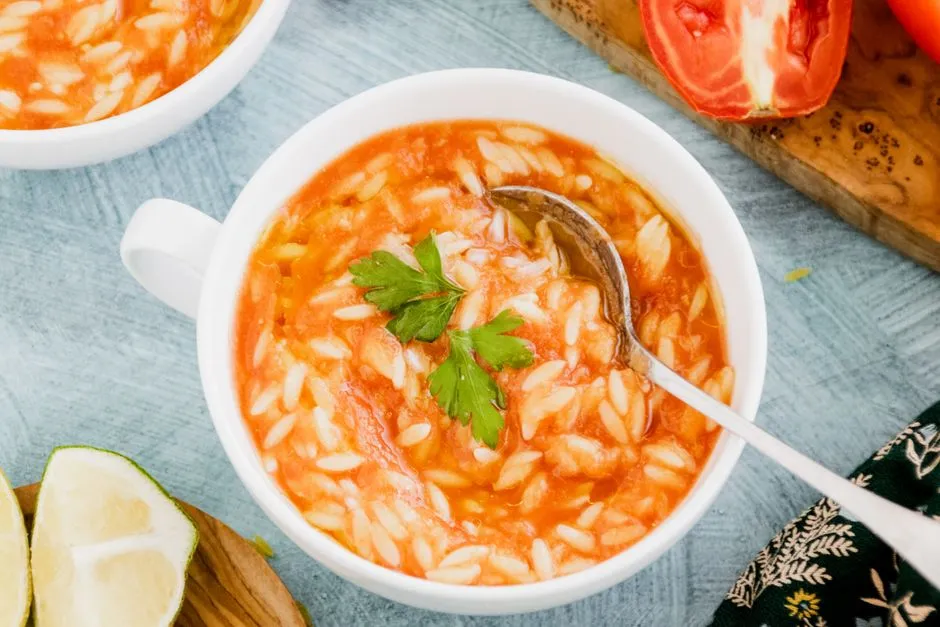
For a pasta version of the same absorption idea, the published one-pan tomato orzo for two shows how a measured liquid and a covered stage work with a different starch.
What if the rice is still firm?
If the rice has a hard centre and the pan looks dry, add two tablespoons of hot water around the edge. Cover and cook on low for three minutes, then rest off the heat for two minutes and check again. Add a second two-tablespoon measure only if the first has been absorbed and the grain is still firm.
If firm rice sits beneath visible broth, do not add more. Cover and cook on low for three minutes, then rest for two. The issue is time or heat transfer, not missing liquid.
If the rice is tender but liquid remains, cook uncovered on low for one or two minutes, stirring gently once. Turn off the heat as soon as the free liquid disappears.
If the base smells scorched, turn off the burner. Do not scrape the dark layer through the food. Spoon the unburnt rice and chickpeas into a clean dish, leaving the bottom behind.
Which substitutions preserve the absorption plan?
Water can replace vegetable broth one-for-one. A mixture also works when the total remains exactly two cups.
Replace the diced carrot with the same measured volume of diced bell pepper. Keep the pieces at 1/4 inch so they soften during the same six-minute stage. A teaspoon of dried oregano can replace the coriander without changing the liquid.
Do not add canned tomatoes, salsa, coconut milk, frozen spinach or a large amount of fresh greens to this version. Each brings water or solids that alter absorption. Add separately cooked greens at the table instead.
Brown, jasmine, basmati, converted and instant rice are not direct substitutes. Their packages may specify different liquid and timing. Use a recipe written for that grain rather than forcing its directions into this pan.
Well-drained canned white beans can replace chickpeas at the same 1 1/2-cup measure, though they are softer and may break during fluffing. Fold and fluff gently. Do not substitute dry beans unless they have been fully cooked first.
To make two portions, halve every input: 3/4 cup chickpeas, 1/2 cup rice, one cup liquid, 1/2 tablespoon oil and half the seasonings and vegetables. Use a smaller covered pan so the rice depth remains similar. Begin checking at the product's stated time; a different pan can still change the result.
Do not double the recipe in the same 12-inch skillet. Two cups dry rice, three cups chickpeas and four cups liquid exceed the depth this timing describes. Use two pans or a separately developed larger-batch method.
How should leftovers be cooled and reheated?
Divide leftovers into shallow containers rather than cooling the full skillet as one deep mass. FoodSafety.gov says to refrigerate perishable food within two hours, or one hour when it has been exposed to temperatures above 90°F (32°C). Its current guidance says to use cooked leftovers within four days and reheat them to 165°F (74°C).
Label containers with the cooking date. Discard food that exceeded the time limit. Reheating does not correct unsafe storage.
Add one tablespoon water per portion before reheating, cover and stir where the appliance permits. Check the centre in more than one place with a food thermometer and require 165°F before serving.
Final pantry checklist
- Measure 1 1/2 cups chickpeas after draining and rinsing.
- Keep the can liquid out of the rice calculation.
- Use one cup of the named rice and exactly two cups broth or water.
- Soften the onion and carrot before adding rice.
- Bring the complete mixture to a simmer before covering.
- Cook on low for 20 minutes with the lid closed.
- Check rice texture in the centre and at the edge.
- Correct dry, firm rice with hot water two tablespoons at a time.
- Add lemon, herbs and any salt only after cooking.
- Cool promptly and reheat leftovers to 165°F.